The short answer
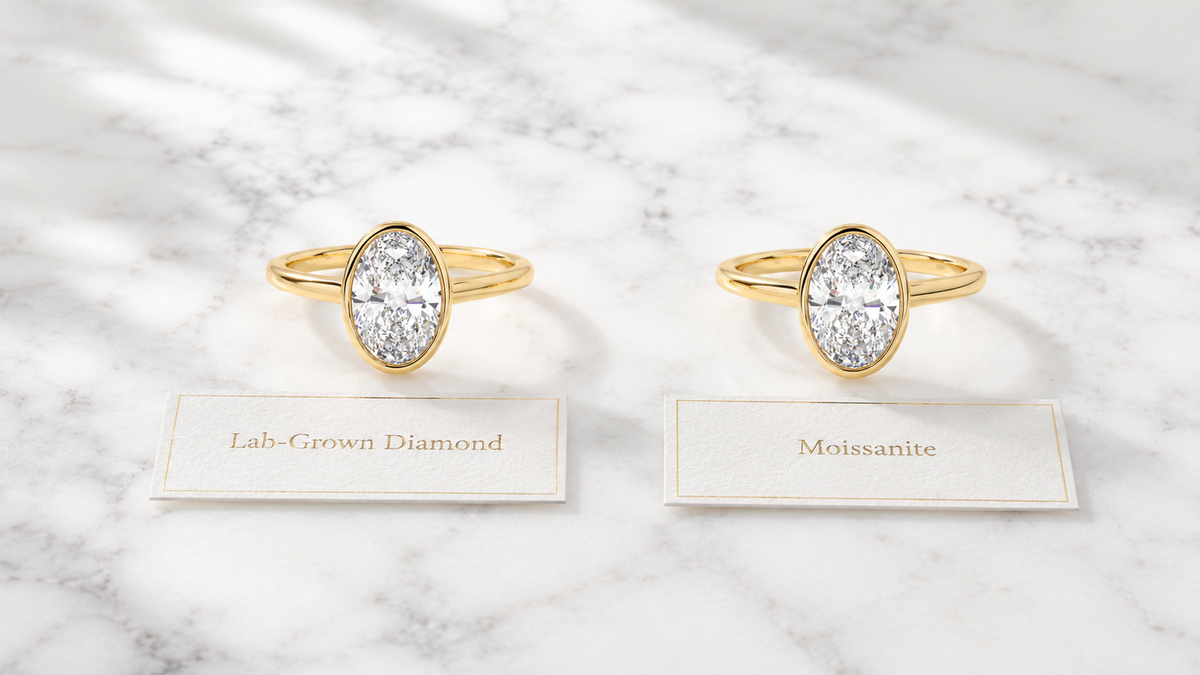
They're different stones, and both are lab-created and lovely — but only one is a diamond.
If you want a real diamond at an honest price, a lab-grown diamond is your answer. If you want maximum sparkle and size for the lowest cost and you're happy with a stone that isn't a diamond, moissanite is a genuinely good option. The key is knowing exactly which one you're buying.
What they're actually made of
This is the real difference, and everything else follows from it.
- Lab-grown diamond — pure carbon, the same as a mined diamond. Hardness of 10 on the Mohs scale. Refractive index of 2.42.
- Moissanite — silicon carbide, a completely different material. Hardness of 9.25. Refractive index of 2.65–2.69.
So a lab-grown diamond is chemically a diamond. Moissanite is its own distinct gemstone that happens to resemble one.

How they look different
They don't sparkle the same way, and once you know what to look for, you can often see it.
Because moissanite bends light more (that higher refractive index), it throws off noticeably more rainbow fire — roughly 2.4 times the colourful flashes of a diamond. Some people love that vivid, disco-like sparkle. Others find it looks a little too flashy and can read as "not a diamond," especially in bright light.
A diamond — lab-grown or natural — has a crisper, whiter brilliance with more restrained fire. That's the classic, understated diamond look most people picture. Side by side under bright light, a trained eye can usually tell them apart by the sparkle alone.
Durability
Both are excellent for everyday wear. A diamond sits at the very top of the hardness scale at 10; moissanite is close behind at 9.25 — second only to diamond among common gemstones. In practical terms, both resist scratching through years of daily wear. The diamond has a slight edge, but for normal life, both hold up beautifully.
Price
This is usually where the decision gets real. From most affordable to most premium:
- Moissanite is the most budget-friendly — the lowest price for a given size.
- Lab-grown diamond sits in the middle — a real diamond at a fraction of a natural diamond's price.
- Natural diamond is the most expensive, carrying the scarcity premium of being mined.
So if pure sparkle-per-rupee is the goal, moissanite wins. If you specifically want a real diamond and honest pricing, a lab-grown diamond is the value choice.
How to tell them apart — and why certification matters
To the untrained eye they can look alike, which is exactly why documentation matters. Gemological tools can distinguish them easily (moissanite is doubly refractive and reads differently on a modern combination tester; a lab-grown diamond tests as a diamond because it is one).
More importantly, they’re certified differently: lab-grown diamonds come with diamond grading reports from recognised, internationally accredited labs like SGL, IGI, or GIA. Moissanite is typically sold with a basic identification card rather than a report from an independent, internationally recognised gemological laboratory — so it is worth being more cautious about moissanite paperwork specifically, and confirming who actually issued it. A real diamond’s report will say diamond, issued by a lab you can verify independently online. If a stone is being sold to you as a diamond, that report is how you confirm it — never take it on the seller’s word alone.
So which should you choose?
Here's the honest framework:
- Choose moissanite if your priority is the biggest, sparkliest stone for the lowest price, and you're genuinely happy that it's moissanite rather than a diamond.
- Choose a lab-grown diamond if you want a real diamond — the true diamond look, feel, and certification — at a price that's a fraction of a mined stone.
There's no wrong answer between two honestly-labelled stones. The one thing our co-founder Khushee is firm about: no one should ever sell you moissanite as a diamond, or let you walk away thinking you bought one when you didn't. Complete clarity about what a stone actually is — that's non-negotiable, whichever you choose.
We built Stella around real, certified lab-grown diamonds because we wanted to offer the genuine diamond experience — the material, the hardness, the classic brilliance, the proper certification — without the mined-diamond price. Moissanite is a lovely stone, and we'd never talk anyone out of it if that's what they want. We just believe you should always know, with total certainty, exactly what's on your hand.
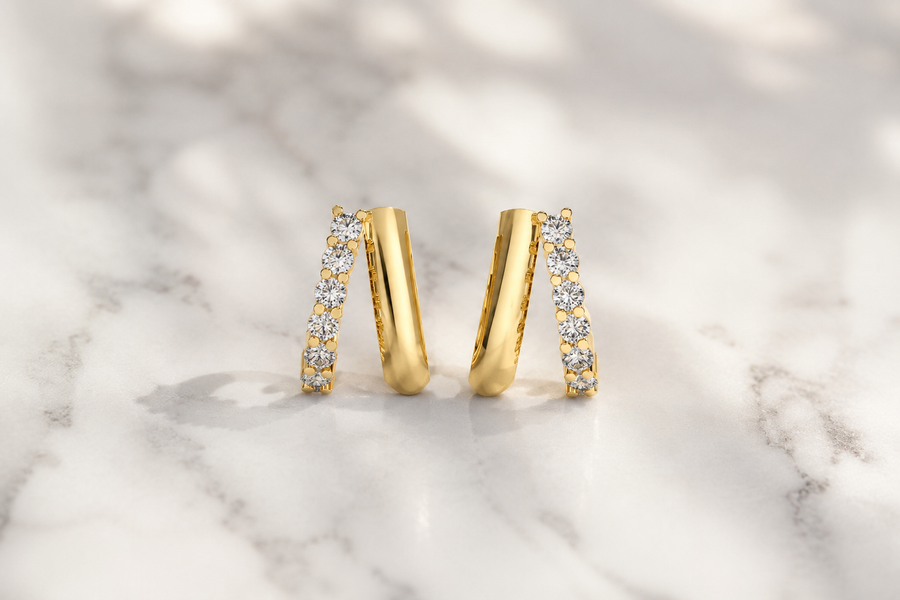
Not sure which is right for you? Message us on WhatsApp and we'll give you a straight answer. Or explore our certified lab-grown diamond rings and lab-grown diamond earrings.
Still asked
Is moissanite a diamond?
No. Moissanite is a separate gemstone made of silicon carbide. A lab-grown diamond is made of pure carbon and is a real diamond. They look similar but are chemically different stones.
Is moissanite or lab-grown diamond more durable?
Both are excellent for daily wear. A lab-grown diamond rates 10 on the Mohs scale (the maximum), and moissanite rates 9.25 — second only to diamond. Both resist scratching well through years of wear.
Why does moissanite sparkle more than a diamond?
Moissanite has a higher refractive index (2.65–2.69 vs a diamond's 2.42), so it bends light more and produces about 2.4 times the rainbow fire. A diamond has a crisper, whiter brilliance.
Is moissanite cheaper than a lab-grown diamond?
Yes. Moissanite is generally the most affordable of the three options, followed by lab-grown diamonds, with natural diamonds being the most expensive.
References