Silver and coloured stones. For the other three hundred days.

from ₹7,000
Add panel image

One stone. Nothing in the way of it. Gold, 9k to 18k.

from ₹35,000
Add panel image
Stella
Search

The Complete Lab-Grown Diamond Buying Guide for India

Buying a lab-grown diamond in India should feel exciting, not confusing. This guide walks you through everything that actually matters — what you're buying, how to judge quality, what certification to demand, how to read pricing honestly, and how to avoid the few genuine pitfalls. Whether this is your first diamond or your fifth, the goal is simple: to help you buy well and know exactly what's on your hand.

6 min read · Updated 23 September 2026

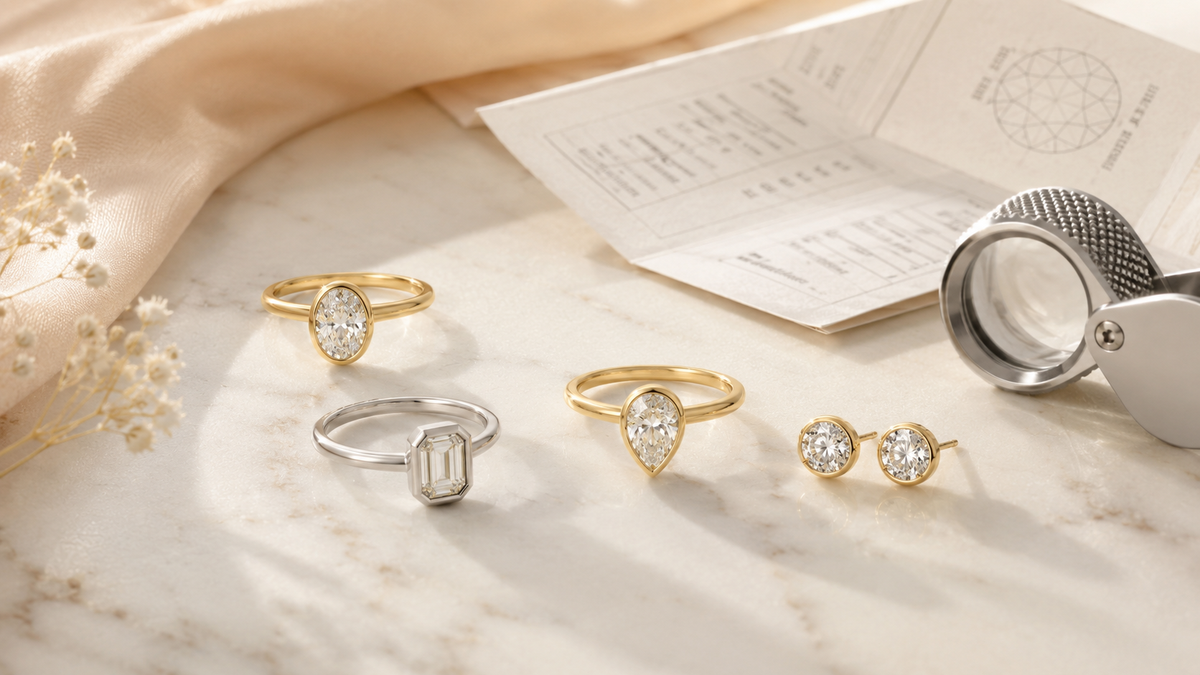
Certified lab-grown diamond rings, earrings, certificate and loupe — Stella Fine Jewellery buying guide
Contents

Five things to know

  1. A lab-grown diamond is a real diamond — judge it on the 4Cs, not the growing method.
  2. Always demand certification: an SGL, IGI, or GIA report stating lab-grown origin, plus a BIS hallmark on the gold.
  3. Prioritise cut, choose eye-clean clarity and near-colourless colour, and let carat fit your budget.
  4. Ask for a clear price breakup of metal, making charges, and diamond cost.
  5. Buy a lab-grown diamond to wear and love, not as a resale investment.

First, what you're actually buying

A lab-grown diamond is a real diamond — pure carbon, the same hardness and brilliance as a mined one. It isn't a simulant like cubic zirconia or moissanite; it's a genuine diamond that was grown in a controlled environment rather than mined. The only real difference from a natural diamond is origin, and that difference shows up mainly in price and resale, not in how the stone looks or lasts.

If you want the full explanation, start with are lab-grown diamonds real diamonds? and the difference between lab-grown and natural diamonds. Everything in this guide builds on that foundation.

Lab-grown diamond jewellery buying guide

Step 1 — Understand the 4Cs (and where to spend)

Every diamond, lab-grown or natural, is graded on four things: cut, colour, clarity, and carat. Understanding them lets you spend your budget where it actually shows.

  • Cut is the most important. It's what makes a diamond sparkle. A well-cut diamond looks brilliant even at a modest colour or clarity grade, so never compromise cut to chase size.
  • Colour is graded D (colourless) down through the alphabet. For white diamonds, the sweet spot for most buyers is a near-colourless grade that looks white to the eye without paying for a lab-perfect D.
  • Clarity measures tiny natural inclusions. You don't need flawless — you need eye-clean, meaning no inclusions visible without magnification.
  • Carat is weight, not size — and it's where price climbs fastest. A slightly smaller, better-cut stone often looks better than a larger, poorly-cut one.

The practical takeaway for India: prioritise cut, choose an eye-clean clarity and a near-colourless grade, and let carat flex to fit your budget. Because lab-grown diamonds cost less than natural, you can usually afford a better grade across all four than you'd expect.

Step 2 — Demand the right certification

This is non-negotiable, and it's where a good jeweller separates themselves from a careless one.

  • Diamond documentation. Your diamond should come with a grading report or jewellery report from a recognised lab. Larger centre stones often have an individual loose-diamond certificate; multi-stone pieces (studs, tennis bracelets) typically come with a jewellery report covering total diamond weight — both are normal. Labs you'll see in India include SGL, IGI, and GIA. The report should clearly state the diamond's origin as lab-grown.
  • Gold documentation. Every gold piece should carry a BIS hallmark — India's official mark of gold purity — showing the karat and a HUID number.
  • Verify it yourself. Many reports (SGL especially) include a QR code you can scan to confirm authenticity.

Read the full detail in our guides on IGI, SGL and GIA certificates and how to check a lab-grown diamond certificate. If a seller can't give you clear documentation, walk away.

Step 3 — Choose your metal

The metal holds your diamond, defines the look, and affects both durability and price.

  • 18KT gold (75% gold) — the premium choice, rich colour, luxurious feel. Beautiful for occasion pieces and gorgeous for daily wear with a little care.
  • 14KT gold (58.5% gold) — harder and more wear-resistant, often the most practical for everyday rings and bracelets, and a little more accessible in price.
  • 9KT gold (37.5% gold) — real gold at a budget-friendly entry point.
  • 925 silver — accessible and stylish, but softer and needs more upkeep; best for fashion-forward pieces rather than lifelong fine jewellery.

Our full gold and silver metal guide breaks down which metal suits which purpose.

Step 4 — Don't get lost in CVD vs HPHT

You may see diamonds described as CVD or HPHT — the two methods used to grow them. Here's the honest shortcut: both produce real diamonds, and neither is better. In fact, many CVD diamonds are HPHT-treated afterward. Judge the stone by its certified 4Cs, not by the growing method. The full explanation is in our CVD vs HPHT guide.

Step 5 — Read the pricing honestly

Lab-grown diamonds cost significantly less than natural diamonds of the same quality — not because they're lesser, but because you're not paying a scarcity premium for something mined from the earth. Read the full reasoning in why lab-grown diamonds are more affordable.

When you're comparing prices, always ask for a clear price breakup:

  • Gold or silver weight and current rate
  • Making charges
  • Diamond cost

That breakup tells you what you're actually paying for and lets you compare jewellers fairly. As a reference point, certified lab-grown diamond jewellery at Stella typically ranges from ₹25,000 to ₹2,50,000, with most buyers shopping between ₹30,000 and ₹1,00,000 — a range where a lab-grown diamond buys noticeably more diamond and better craftsmanship than a natural stone would.

Step 6 — Be clear-eyed about resale and investment

We'd rather tell you this ourselves than have you learn it later: lab-grown diamonds generally do not hold resale value the way rare natural diamonds can, because they aren't scarce in the same way. You can read the honest, full picture in our resale value guide.

Our co-founder Khushee is direct with customers about this: buy a lab-grown diamond because you want to wear it and love it, and if you're thinking about your money, invest the difference where investments actually belong. A beautiful diamond you'll enjoy every day, plus savings put to sensible use, is a smarter combination than locking a large sum into a stone and hoping it appreciates.

Step 7 — Know the one real pitfall: mis-labelling

The single thing to watch for is a stone being sold as something it isn't. Moissanite in particular looks diamond-like but is a different material (silicon carbide), with more rainbow fire and a lower price. It's a lovely stone in its own right — but it is not a diamond, and no one should ever sell it to you as one. Our lab-grown diamond vs moissanite guide shows you exactly how to tell them apart. Your certificate is your protection: a real diamond's report says diamond.

Step 8 — Match the piece to the occasion

  • Engagement & milestone pieces — this is where you might choose a larger certified centre stone; explore engagement rings.
  • Daily wear — studs, everyday rings, pendants and tennis bracelets in 14KT gold; see our daily wear collection and the daily wear guide.
  • Gifting — certified, hallmarked pieces make confident gifts because the recipient can verify exactly what they've received.

If you have something specific in mind, our custom design service can build it to your preferences.

Infographic: pre-purchase checklist

Your pre-purchase checklist

Before you buy any lab-grown diamond jewellery, confirm:

  • The diamond's origin is clearly stated as lab-grown on its report
  • The report is from a recognised lab (SGL, IGI, GIA) and is verifiable
  • The piece is eye-clean and well-cut
  • The gold carries a BIS hallmark matching the stated karat
  • You've received a clear price breakup (metal, making, diamond)
  • You know whether you have a loose-diamond certificate or a jewellery report
  • Any QR code on the report scans and verifies

If all seven check out, you're buying well.

The Stella promise

Every Stella piece comes with an SGL jewellery report stating lab-grown origin, BIS-hallmarked gold, and full documentation — because you can only choose with confidence when you genuinely know what you're choosing. That's the whole idea behind how we built this brand: real diamonds, honest pricing, complete transparency.

Ready to buy, or still have questions? Message us on WhatsApp — ask us anything, including the awkward ones. Or browse our certified lab-grown diamond rings, earrings, and jewellery under ₹50,000.

Goes deeper

Lab-Grown Diamonds vs Natural Diamonds: Complete Comparison for Indian Buyers →Are Lab-Grown Diamonds Real Diamonds? →18KT, 14KT, 9KT Gold and 925 Silver: Which Metal Should You Choose for Fine Jewellery? →IGI, SGL, GIA and Diamond Certificates: What Should You Check Before Buying Lab-Grown Diamond Jewellery? →Are Lab-Grown Diamonds Worth Buying in India? →Do Lab-Grown Diamonds Have Resale Value? →CVD vs HPHT Diamonds: What Is the Difference? →How to Check a Lab-Grown Diamond Certificate →Lab-Grown Diamonds vs Moissanite: What Should You Buy? →Are Lab-Grown Diamonds More Sustainable Than Natural Diamonds? →Why Are Lab-Grown Diamonds More Affordable Than Natural Diamonds? →

References

Your bag

0 pieces · Nothing here expires. Take your time.