The short answer
A lab-grown diamond is a real diamond. Full stop.
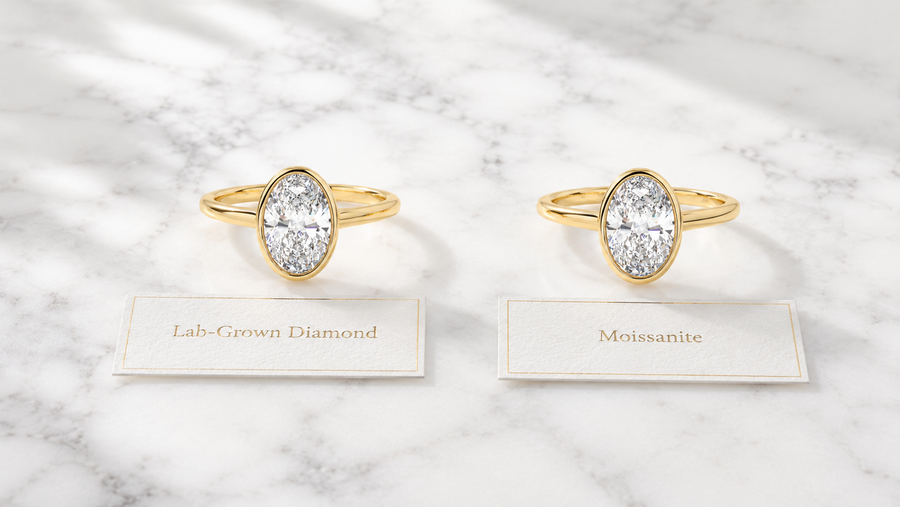
The distinction that matters isn't lab-grown vs real — it's diamond vs imitation. Cubic zirconia and moissanite are imitations: they look like diamonds but are made of entirely different materials. A lab-grown diamond is not an imitation of anything. It is carbon, crystallised into a diamond, exactly like a mined one.
What actually makes a diamond a diamond
A diamond is pure carbon arranged in a specific crystal structure. That structure is what gives a diamond its famous properties: a hardness of 10 on the Mohs scale (the hardest natural material there is), a refractive index of 2.42 (the source of that unmistakable sparkle), and a specific gravity of 3.52.
A lab-grown diamond shares every one of these. Same hardness. Same sparkle. Same density. Place a lab-grown diamond and a mined diamond of the same cut, colour, and clarity side by side, and there is nothing to tell them apart — not to your eye, not to your jeweller's loupe, not to a standard diamond tester. They are the same thing, grown in two different places.
So why do so many people ask if they're "fake"?
Because "grown in a lab" sounds like it should mean artificial. It's a completely fair instinct — and it's the single most common question we get at Stella.
When a customer asks our co-founder Krisha this across the counter, she never bristles at it. She gets it. Most people buying a lab-grown diamond are buying their first serious diamond, and they've grown up with one story: that a diamond's worth comes from the earth and the years. So the question underneath "is it real?" is usually "am I being sold something lesser?"
The honest answer is no — but you deserve to understand why, not just be told to trust us.
What the science and the law both say
In 2018, the United States Federal Trade Commission — the body that governs how jewellery can be advertised — updated its official Jewelry Guides and removed the word "natural" from the definition of a diamond. Their reasoning was direct: lab-grown diamonds have "essentially the same optical, physical, and chemical properties as mined diamonds." Therefore, they are diamonds.
That wasn't marketing. It was a regulator looking at the science and correcting an outdated definition.
Here's the part most brands skip, and the part we think matters most: the same ruling also says a lab-grown diamond must always be clearly disclosed as lab-grown. You should never have to squint at fine print to find out where your diamond came from. At Stella, that isn't a compliance box — it's the whole point. You can only make a confident choice if you actually know what you're choosing.

Can anyone tell the difference?
Not by looking. A trained gemologist cannot distinguish a lab-grown diamond from a mined one by eye, and neither can a standard handheld diamond tester — because both are testing for diamond, and a lab-grown stone is a diamond, so it passes.
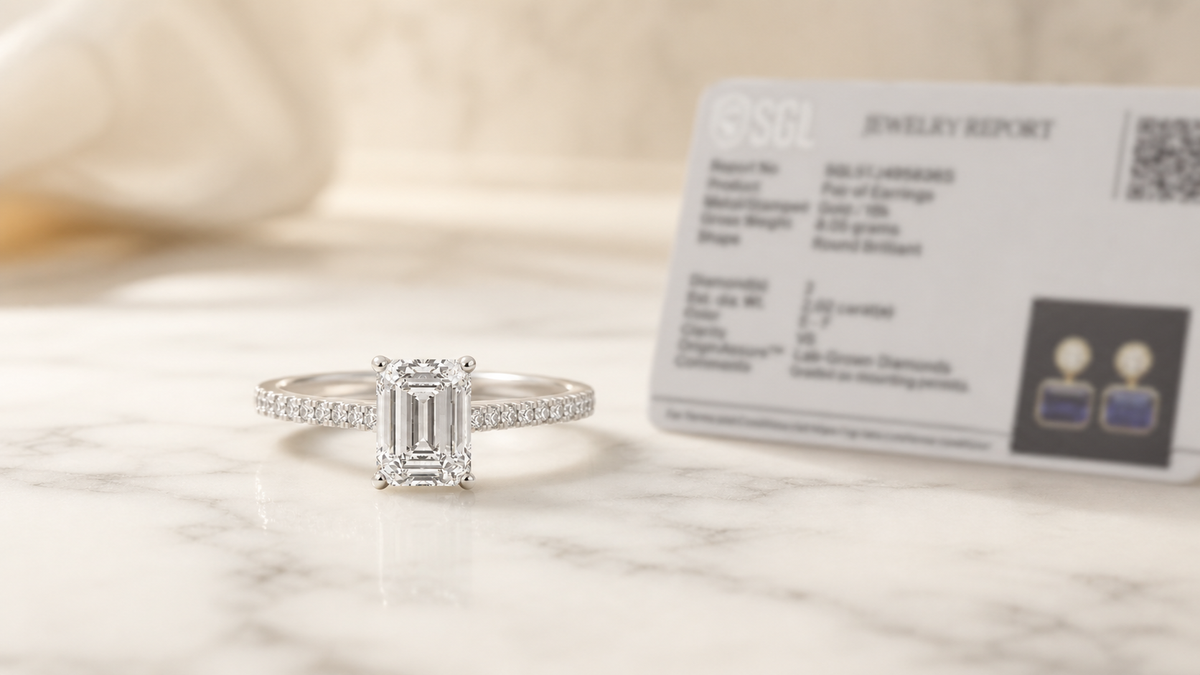
The only way to confirm origin is specialised laboratory equipment that reads the tiny growth patterns left behind by how the crystal formed. That's exactly why certification exists: your grading report states, in writing, that your diamond is lab-grown, alongside its weight, colour, and clarity. You're never left guessing.
The honest part: "real" doesn't mean "identical in every way"
Being the same material isn't the same as being identical in every respect — and we'd rather tell you that ourselves than let you find out later.
The real difference is origin, and origin affects two things: price and resale.
On price — a lab-grown diamond usually costs meaningfully less than a mined diamond of the same quality. That lower price is not a sign of a lower-quality stone. You're simply not paying the scarcity premium that comes from a diamond being dug out of the ground. The craftsmanship, the certification, the gold, the sparkle on your hand — all of that is the same. You're paying for the diamond, not for the story of its rarity.
On resale — because lab-grown diamonds are more widely produced, they generally don't hold resale value the way rare mined diamonds can. We say this openly. A lab-grown diamond is something to wear and love, not a financial instrument.
This is where our co-founder Khushee is blunt with people: buy the diamond because you want to wear it, and if you're thinking about your money, invest the difference where investments actually belong. That combination — a beautiful diamond you'll genuinely enjoy, plus savings put to better use — makes more sense for most people than locking a large sum into a stone hoping it appreciates. We'd rather lose a sale to that honesty than win one by letting you believe something that isn't true.
How Stella makes sure you always know exactly what you have
Every Stella piece comes with an SGL jewellery report confirming the diamond's origin as lab-grown, its weight, and its quality — many with a QR code you can scan to verify it yourself. Every gold piece carries a BIS hallmark, India's official mark of gold purity. Nothing about what you're buying is left vague.
That's what we mean when we talk about empowering people to buy well. A first diamond should feel exciting and clear — not like a test you're worried about failing.
Still have a question before you buy? Message us on WhatsApp — ask us anything, including the awkward ones. Or browse our certified lab-grown diamond rings and lab-grown diamond earrings to see what real, honestly-priced fine jewellery looks like.
Still asked
Are lab-grown diamonds real diamonds?
Yes. A lab-grown diamond has the same carbon crystal structure, hardness, and optical properties as a mined diamond. The only difference is that it was grown in a controlled environment rather than mined from the earth. It is a real diamond, not a simulant.
Are lab-grown diamonds the same as cubic zirconia or moissanite?
No. Cubic zirconia and moissanite are diamond simulants — they imitate the look of a diamond but are made of different materials. A lab-grown diamond is genuinely a diamond, made of pure carbon, and is far harder and more brilliant than either simulant.
Can a jeweller tell a lab-grown diamond from a natural one?
Not by eye or with a standard diamond tester, because a lab-grown diamond genuinely is a diamond. Only specialised laboratory equipment can identify its origin, which is why every certified diamond states its origin on its grading report.
Do lab-grown diamonds pass a diamond tester?
Yes. A standard diamond tester checks whether a stone is a diamond — and since a lab-grown diamond is a real diamond, it passes.
References